
Most businesses don’t think about their HVAC system until something goes wrong. That’s exactly when it gets expensive.
Commercial HVAC maintenance isn’t a nice-to-have — it’s the difference between a system that runs efficiently for fifteen years and one that fails at the worst possible moment, takes the office down with it, and costs three times what routine servicing would have. The maths isn’t complicated. The discipline to act on it is where most businesses fall short.
Here’s what consistent maintenance actually involves — and what neglecting it really costs.
What These Systems Are Actually Managing
Commercial HVAC systems are considerably more complex than residential units. They regulate temperature, humidity, and air quality across large spaces with high occupancy, often running continuously across multiple seasons. The core components — furnaces, air conditioning units, heat pumps, ductwork, thermostats — all interact, and a problem in one area puts strain on everything else.
That complexity is precisely why specialised knowledge matters. These aren’t systems you can troubleshoot with a YouTube video and an afternoon free.
What Happens When Maintenance Gets Skipped
Filters clog. Coils get dirty. Belts wear out. None of these are dramatic failures on their own — but each one forces the system to work harder to hit the same temperature targets. Energy consumption climbs. Components degrade faster under the additional strain. What started as a clogged filter quietly becomes a compressor running at capacity it wasn’t designed for.
Air quality deteriorates too. Dust and contaminants accumulate inside the system and circulate through the building. Employees with allergies notice first. Productivity follows. It’s a slow erosion that doesn’t show up on a single bad day — it compounds across weeks and months until someone starts wondering why the team seems perpetually run-down.
Then there’s the failure risk. Small problems left unaddressed don’t stay small. They escalate into emergency repairs — the kind that require immediate callouts, carry premium pricing, and potentially take the system offline for days. Lost revenue, disrupted operations, emergency contractor fees. All of it avoidable.
What Good Commercial HVAC Maintenance Actually Looks Like
Twice a year is the baseline for most commercial systems — typically spring and autumn, ahead of peak cooling and heating demand. That’s the minimum. Buildings with high occupancy, sensitive equipment, or dusty environments often need more frequent attention.
Filters need checking monthly and replacing every one to three months depending on conditions. That’s a simple task that has an outsized impact on system performance.
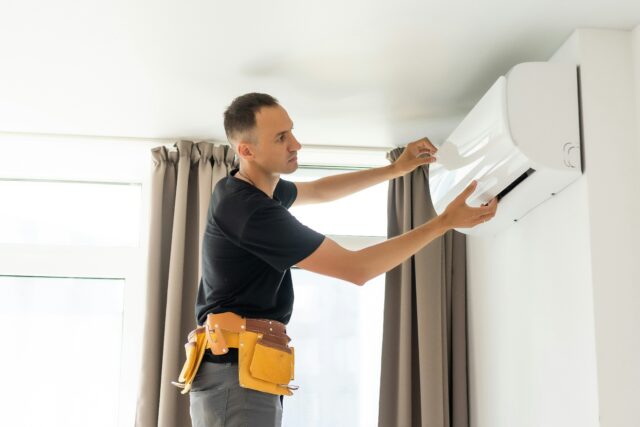
A proper maintenance visit should offer a comprehensive range of air conditioning services such as inspections of filters, coils, and ductwork; lubrication of moving parts; tightening of electrical connections; thermostat calibration; and a check of system controls. The goal is catching deterioration early — before it becomes a repair job rather than a maintenance task.
Between professional visits, in-house teams can help by keeping the area around outdoor units clear of debris, checking thermostat settings aren’t wasting energy, and flagging anything unusual. These steps don’t replace professional servicing, but they extend the value of it.
Choosing a Provider
Experience with commercial systems specifically matters here. A provider used to residential work isn’t necessarily equipped for the complexity of a large commercial installation. Look for demonstrated track record, a full range of services — inspections, cleaning, repairs, replacements — and the ability to build a maintenance plan around your building’s actual needs rather than a generic schedule.
Documentation matters too. A good provider records every visit, every finding, every action taken. That paper trail helps you track system health over time and plan capital expenditure before it becomes urgent.
The Cost Question
Businesses that skip commercial HVAC maintenance typically cite cost as the reason. The logic inverts quickly under scrutiny.
Routine servicing costs a fraction of emergency repair work. Emergency repair costs a fraction of full system replacement. And system replacement — on top of the downtime, disruption, and lost productivity it brings — is the outcome that consistent maintenance is specifically designed to prevent.
A well-maintained system also runs more efficiently. Lower energy consumption means lower utility bills every single month. Over years, that saving compounds into something significant.
The businesses that treat commercial HVAC maintenance as an overhead to minimise tend to be the ones facing the largest unplanned costs. The ones that treat it as standard operational investment rarely have to think about their HVAC system at all — which is exactly the point.