
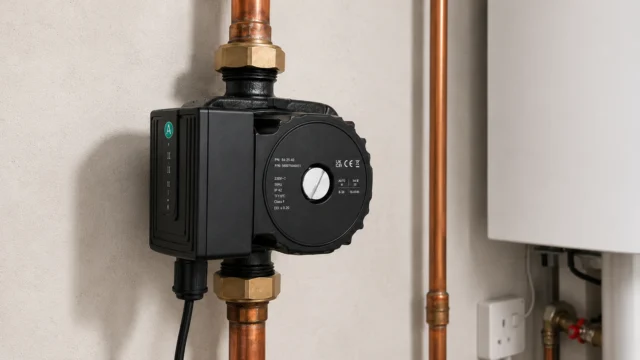
Low water pressure. It’s one of those slow-burn frustrations that starts as a mild annoyance — a weak shower, a tap that dribbles — and eventually has you Googling solutions at midnight. For plenty of UK homeowners, especially in London and other cities with ageing pipe networks, domestic water pumps are the fix that actually works.
Here’s what you need to know before buying one.
What They Do (and Why You Might Need One)
A domestic water pump does one thing well: it boosts pressure and improves flow throughout your home. These aren’t the hulking industrial machines you’d see on a building site — modern domestic models are compact, relatively quiet, and built to slot into standard home plumbing without drama.
The scenarios where you’d actually need one? More common than you’d think.
Properties in dense urban areas — London especially — sometimes receive mains pressure that’s just too low to be useful. Older streets, high-rise buildings, areas with Victorian-era infrastructure — all of these can leave homeowners dealing with showers that barely rinse shampoo out. Then there’s the multi-storey problem: gravity isn’t your friend when you’re trying to push water up to a third-floor bathroom. And loft conversions are notorious for this — add a shower up there without a pump, and you’ll know about it.
Multiple outlets running simultaneously is another common trigger. If pressure tanks the moment someone else turns on a tap, that’s a flow problem a good pump solves quickly.
The Types Worth Knowing About
Not all domestic water pumps are built for the same job.
Single-impeller pumps are the entry point — smaller homes, single outlets, tight budgets. They work well when you just need one area sorted.
Twin-impeller pumps boost hot and cold simultaneously, which makes them the go-to for showers and bathrooms in larger properties. If you’ve got a family home with multiple bathrooms in use at once, this is usually where you end up.
Inline booster pumps connect directly to the mains supply line. These tackle the whole-house problem — useful when overall incoming pressure is the issue, not just one outlet.
Circulation pumps are a different beast entirely. They’re not about tap pressure; they move water around heating and hot water systems. Central heating, unvented cylinders — that’s their territory.
What to Actually Look At When Choosing
Flow rate first. Measured in litres per minute, this needs to match your household’s peak demand — not just average use. Underspec here and you’ll still be frustrated.
Head pressure matters a lot in multi-storey properties. It determines how high the pump can push water. For a London townhouse with three floors, this number needs serious attention.
Noise is worth thinking about more than most people do. If your airing cupboard sits next to a bedroom, a loud pump becomes a problem fast. Look for models with vibration dampening built in — or plan to add it during installation.
Energy efficiency has improved dramatically. A-rated modern domestic water pumps draw significantly less electricity than older models. Over years of use, that gap adds up.
Installation: Don’t Skip the Professional
UK Building Regulations and the Water Supply (Water Fittings) Regulations both have specific requirements — especially where a pump connects to the mains supply. In London, your local water authority may layer on additional conditions. This isn’t the place for DIY experimentation.
A qualified plumber or heating engineer will typically mount the pump in an airing cupboard, under a bath, or next to a hot water cylinder. Vibration dampening matters here — a pump bolted to a hard surface without it will transmit noise through the whole house.
Keeping It Running
Maintenance is straightforward. Check for leaks around fittings a couple of times a year. If the pump hasn’t run in a while, run it briefly — extended inactivity can cause seizing. Fit an inline filter upstream of the pump; in London especially, older pipes shed debris that accelerates wear.
And listen. A new hum, rattle, or grinding noise is the pump telling you something’s wrong. Catch it early and you’re looking at a minor fix. Ignore it, and you’re looking at a replacement.
When Replacement Makes More Sense Than Repair
Ten years is a reasonable benchmark. If your pump is past that point and struggling to hold consistent pressure — or developing recurring faults — a modern replacement will outperform it on every metric: quieter, more efficient, more reliable. The repair economics rarely favour an old unit.
BritTherm’s domestic water pumps are designed specifically for UK homes — period properties in London, modern new-builds everywhere else. Quiet, efficient, low-maintenance. Worth looking at if you’re ready to stop putting up with poor pressure.