Whether you're planning a roof replacement in St Albans, a home extension in Watford or a commercial refurbishment in Hertford, choosing the right scaffolding is an important part of project planning.
The right scaffold provides safe access for workers, suitable working platforms and a secure environment for construction, maintenance and repair work. However, scaffolding requirements vary depending on the building, project, site conditions and duration of the work.
If you're looking for a scaffolding company in Hertfordshire, it's important to understand what to consider before choosing a contractor.
Understand Your Project Requirements
The first step is to identify the type of work being carried out. Different projects require different scaffolding arrangements.
Common applications include:
- Roof repairs and replacements
- House extensions
- Loft conversions
- New-build construction
- Brickwork and masonry
- Rendering and external decoration
- Window installation
- Chimney repairs
- Commercial refurbishment
- Industrial maintenance
For example, roofing work may require platforms around roof level, while brickwork may require additional space for workers and materials.
The scaffold should therefore be selected according to the work being performed rather than simply the height of the building.
Under the Work at Height Regulations 2005, work at height must be properly planned and carried out using suitable equipment. The Health and Safety Executive (HSE) recommends selecting work-at-height equipment according to the circumstances and risks involved.
Assess the Building and Site
Before scaffolding is erected, the building and surrounding area should be assessed.
Important considerations include:
- Building height and dimensions
- Roof design
- Extensions and projections
- Ground conditions
- Available working space
- Access routes
- Nearby structures
- Public footpaths
- Roads and vehicle access
- Overhead or underground services
Hertfordshire has a mixture of residential properties, commercial premises and older buildings, so site conditions can vary significantly between projects.
A proper site assessment helps identify potential restrictions and determine the most appropriate scaffolding arrangement.
Consider Ground Conditions
Scaffolding requires a stable and suitable foundation. Uneven ground, slopes, soft surfaces, gardens and restricted areas can affect how a scaffold is installed.
The condition of the ground should be considered during the planning process, and appropriate measures should be used where necessary to support and distribute the scaffold loads.
Scaffolding should never be erected on an unsuitable surface simply for convenience.
Choose the Right Type of Scaffolding
There are several types of scaffolding used across construction and maintenance projects.
Independent Scaffolding
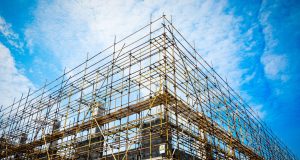
Independent scaffolding is commonly used for building, maintenance and refurbishment work. It provides working platforms alongside a structure and can be adapted to different building configurations.
Scaffolding Towers
Access towers can be suitable for shorter-duration tasks where workers need access to specific elevated areas without requiring scaffolding around the entire building.
Birdcage Scaffolding
Birdcage scaffolds are commonly used where workers need access across large internal areas, such as ceilings, atriums and industrial spaces.
Temporary Roof Scaffolding
Temporary roof systems can provide weather protection while roofing or construction work is being carried out. They can be particularly useful during major roof renovation or replacement projects.
Commercial Scaffolding
Commercial scaffolding may require more extensive planning because of larger structures, increased loading requirements, multiple contractors and longer project durations.
The appropriate solution will depend on the specific building and work involved.
Consider Loading Requirements
Scaffolding may need to support more than workers. Depending on the project, platforms can also carry tools, bricks, roofing materials, timber, render and other equipment.
Expected loads should therefore be considered during the planning and design stage.
Working platforms should never be overloaded, as excessive loading can compromise the stability and safety of the scaffold.
For more complex structures or unusual loading requirements, a specific scaffold design may be necessary.
Understand TG20:21
For tube-and-fitting scaffolding, TG20:21 is an important industry reference.
Produced by the National Access and Scaffolding Confederation (NASC), TG20 provides guidance for the safe use of tube-and-fitting scaffolding and covers a range of common configurations.
These include:
- Independent scaffolds
- Birdcage scaffolds
- Loading bays
- Access towers
- Chimney scaffolds
- Free-standing towers
Where a scaffold falls outside recognised standard configurations, additional design and technical assessment may be required.
This is particularly relevant to complex buildings, temporary roofs, unusual structures and scaffolds involving unusual loads.
Plan Safe Access and Edge Protection
A scaffold should provide practical and safe access to the working area.
Depending on the project, access may involve ladders, stair towers, access towers or specifically designed access points.
Scaffolding should also provide suitable protection against falls from height. Depending on the configuration, this can include:
- Guard rails
- Intermediate rails
- Toe boards
- Fully boarded platforms
- Protection from falling objects
Collective protection is an important principle of work-at-height safety because it can protect multiple workers rather than relying solely on individual fall protection.
Consider Public Safety
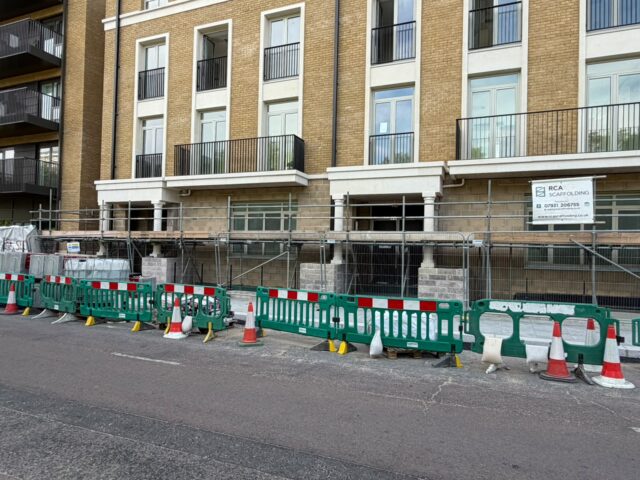
Scaffolding can affect people beyond those working on the project.
Residential and commercial projects may be located near:
- Public footpaths
- Roads
- Neighbouring properties
- Shops and businesses
- Parking areas
- Pedestrian routes
A competent scaffolding contractor should consider how the structure will interact with the surrounding environment and whether additional protective measures are required.
Take Weather Conditions Into Account
Weather can affect work at height and the condition of scaffolding.
Strong winds, heavy rain, ice and other adverse conditions may create additional risks. Scaffolding should therefore be inspected and maintained appropriately, particularly following circumstances that could affect its stability.
For roofing projects, temporary roof systems may provide additional protection where work needs to continue during changing weather conditions.
Check Inspection and Handover Procedures
Scaffolding should not simply be erected and assumed to be safe.
Under the Work at Height Regulations, scaffolding used for construction work must be inspected at appropriate intervals and following circumstances that could affect its safety.
This generally includes inspection:
- Before first use
- At regular intervals
- Following substantial alteration
- Following circumstances such as adverse weather that could affect stability
Inspections should be carried out by someone with the necessary competence, knowledge and experience.
Check the Contractor's Competence
When selecting a contractor for scaffolding services, price should not be the only consideration.
Ask about:
- Relevant training and qualifications
- Previous experience
- Insurance
- Health and safety procedures
- Inspection arrangements
- Design capabilities
- Previous projects
- Industry standards followed
CISRS (Construction Industry Scaffolders Record Scheme) is a recognised training and certification scheme within the UK scaffolding industry.
For more complex projects, confirming the contractor has appropriate technical competence is particularly important.
Compare Scaffolding Quotes Carefully
Obtaining several quotations can help establish the expected cost of your project. However, make sure you understand what each quotation includes.
Check whether the price covers:
- Site assessment
- Scaffold design where required
- Erection
- Hire period
- Inspections
- Alterations
- Transport
- Dismantling
- Additional visits
- Protective measures
The cheapest quotation isn't necessarily the best value if important services are excluded.
Final Considerations
Choosing the right scaffolding for a Hertfordshire building project is about more than finding the lowest price. The scaffold needs to be appropriate for the building, suitable for the work and properly planned around the risks involved.
Before work begins, ensure that factors such as ground conditions, access, loading, edge protection, public safety, inspections and relevant industry guidance have been considered.
Whether you're planning a residential renovation, roof replacement, extension or commercial development, selecting appropriate scaffolding services can help create a safer and more efficient working environment.
The best scaffolding solution isn't necessarily the largest or cheapest option. It is the one properly planned for the specific project and installed, inspected and maintained by competent professionals.