
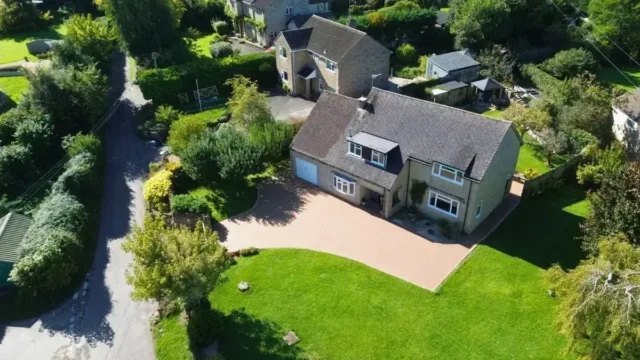
Let’s get the awkward bit out of the way: resin costs more than tarmac. Any driveway firm that tiptoes around that isn’t being straight with you. So the question worth asking isn’t “is it cheap” it’s whether the extra outlay actually gives you something back. Sometimes it clearly does. Now and then it doesn’t. What follows is the version you won’t find in a glossy brochure, written for a Swindon home.
Where Resin Pays You Back
Look at how long it lasts first. Laid on a decent sub-base, a resin bound drive will see out 20-25 years. Tarmac tends to give you 10-20 before the cracks and oil marks arrive, and it wants re-sealing every three to five years in between. Block paving holds up too, but you’ll be pulling weeds and topping up joint sand for the life of it. Resin? A sweep and a wash once a year. Stretch that over two decades and the difference is both money and weekends you get back.
There’s the drainage angle as well. Because resin bound surfacing lets water pass straight through into the ground, front gardens don’t trip the planning rules that catch solid surfaces over 5m² (a requirement that’s been in place since 2008). No standing puddles, and no sheet of rainwater running off your drive and across the path.
And then there’s how it looks. You’re not stuck with black. Resin comes in a whole range of aggregate mixes buff, silver, charcoal, terracotta so it can be picked to sit against your brickwork instead of fighting it. On a Victorian place in Old Town, or one of the 1930s semis over towards Croft Road, that’s worth something no amount of tarmac will buy.
The Price Gap, And What Closes It
A typical Swindon front drive of 30-40m² will land somewhere between £2,500 and £6,000, depending on what’s underneath and which aggregate you go for. The same area in tarmac is more like £1,500-£3,000. Gravel comes in under that again.
So you’re paying roughly £1,000-£3,000 more than tarmac on an average job. Here’s what that premium covers: no re-sealing bills (tarmac runs £3-£8 per m² every few years), no resurfacing around year 12-15 (tarmac usually needs it), and a drive that still looks the part when you put the house on the market. Do the sums across 15-20 years and the gap mostly disappears. Do them across five and it doesn’t, which is really why the answer comes down to how long you plan to stay.
The Part That Actually Goes Wrong
Here’s the thing people get wrong about resin failures: it’s almost never the resin. It’s how it went down.
That finished surface is only a 15-18mm skin of decorative stone. Everything depends on what it’s sitting on. Put it over a sub-base that’s too shallow, poorly compacted, or barely there — and yes, some outfits genuinely trowel resin straight onto cracked concrete and cross their fingers — and it’ll split within a few years however good the mix was. The catch is you can’t see any of that once the job’s finished, which is precisely how corner-cutters keep getting away with it. Swindon’s clay only sharpens the problem: it swells and shrinks through the year, and a thin sub-base passes every bit of that movement up into the surface.
The smaller gripes are worth a mention too. Patch repairs do work, but a fresh patch takes a year or more of weathering before it truly blends with the older surface around it. Cheap resin that isn’t UV-stable still floating around on the budget end will go yellow in the sun. And a poorly chosen mix can soften in a proper heatwave, enough that a motorbike stand leaves its mark.
How It Stacks Up Against Everything Else?
Next to block paving, resin’s big win is that it has no joints so no weeds, no sand washing out, nowhere for moss to get a grip. Block paving looks smart on day one, but those joints are a standing commitment; anyone who’s lost a bank holiday to scraping them will tell you.
Next to tarmac, resin costs more but gives you colour, skips the re-sealing, won’t go soft in the heat, and shrugs off the oil drips that eat into bitumen.
Next to gravel, well gravel’s the cheapest way to cover a drive and it drains beautifully, but it wanders onto the lawn and into the road, ruts under your tires, and needs regular topping up. Grand for a farmhouse track. Less fun on a suburban plot where half of it ends up in the gutter.
None of these are wrong answers. They’re trade-offs, and for plenty of people the budget makes the call fairly enough.
Why Swindon’s Clay Tips The Scales
The maths leans harder towards resin here than it would in a lot of towns, and clay is the reason.
Most of residential Swindon sits on heavy clay Stratton, Walcot, Liden, Wroughton, Covingham, and the newer builds out at Wichelstowe and Badbury Park included. Clay is slow to drain and it moves with the moisture. Lay something solid over it and water gets trapped beneath; then every winter’s freeze-thaw prises the cracks a fraction wider. It’s exactly why so many of the older tarmac drives around town are crumbling at their edges.
A permeable resin surface over a proper stone base keeps that clay drier and steadier underneath, so the top takes far less seasonal punishment. It’s the same product you’d lay anywhere, but it earns its keep on this ground more than it would on the free-draining chalk down Salisbury way. The catch cuts the other way too, mind: a skimped base fails *faster* on clay, which is exactly why who lays it matters as much as what they lay.
When Resin Is The Wrong Call
Short list, because “it’s perfect for everybody” is a sales line, not the truth.
Moving on within a year or two? Spend less. A neat gravel or tarmac job clears the eyesore without the premium, and you won’t be around long enough to bank the maintenance savings anyway. Only able to stretch to the rock-bottom resin quote you’ve been given? Tread carefully the gap between a £4,500 quote and a £2,800 one for the same drive is nearly always the sub-base, and it’s the cheap one that lets go first. A properly built tarmac drive beats a corner-cut resin one every single time.
One more: if a 7.5-tonne work van lives on your drive in the same spot day after day, say so up front. That changes the sub-base specification, and a standard residential build-up was never meant to carry it.
So — Worth It?
If you’re settled in a Swindon home for five years or more and working to a sensible budget, then yes resin earns it. The maintenance you don’t do, the planning you don’t need, the way it handles clay, the fact it still looks good years on: it all stacks up over time. The extra over tarmac buys you durability you’ll genuinely get the use of.
The single thing that decides whether you actually see that value is the install. The material rarely lets you down; the groundwork does. So ask every firm what sub-base depth they’re pricing in, what happens if they hit bad ground, and whether muck-away is in the number. The ones who answer plainly are the ones worth shortlisting a specialist installer like RPS Resin Driveways](https://www.rpsresindriveways.co.uk) will put the sub-base spec in writing so you can compare quotes properly rather than on the bottom line alone.
Want real figures for your own drive instead of a range off a page? Book a free resin driveway quote a proper installer will assess the ground, measure up, and hand you a firm price with the build-up written down, so every quote you’re weighing is genuinely like-for-like.