
Buyers who have sat through one August in a south-facing flat tend to ask about shade before they ask about kitchens, and an estate agency in Marbella will usually know which buildings cope best with the heat. Cooling is cheaper to design in than to retrofit, but plenty can be done to an existing home. Many of the old Andalusian methods are still the best ones, and they work in British heatwaves too.
Stop the sun at the window
Once sunlight is through the glass, the heat is already inside. External shutters, awnings and blinds block it before that happens, and they beat internal curtains by a wide margin. In traditional Andalusian houses the shutters on the sunny side stay closed through the day and open again in the evening. If external shading isn’t possible, reflective window film and light-coloured blinds help, though not as much.
Move air at night
After dark, open windows on opposite sides of the house to create a through draught and flush out the day’s heat. Close them in the morning, before the sun is high, and keep the shutters shut. A small fan standing in an open window and pointing outwards speeds the process up and costs very little to run.
Mind the roof and the walls
Light colours reflect heat and dark ones absorb it. Lime wash on an outside wall is cheap, traditional and effective, and it is partly why so many southern villages are white. Insulation in the loft keeps heat out in summer as well as in during winter, which is a good reason to put more of it in. Thick masonry walls absorb heat slowly and give it back at night, so they work best when the house is opened up in the evening.
Fans and air conditioning
A ceiling fan uses a fraction of the electricity of an air conditioning unit and makes a room feel several degrees cooler by moving air across the skin. In summer, set it to turn anticlockwise when viewed from below, so that it pushes air downwards. If you do install air conditioning, size it to the room. An oversized unit cools quickly, switches off, and then switches on again, which wastes energy and leaves the air feeling clammy. Keep the outdoor unit in the shade, where it works more efficiently.
Plants and courtyards
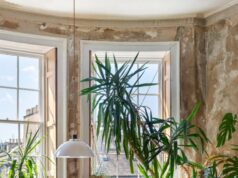
A deciduous tree on the west side of a house gives shade in summer and lets the light through once the leaves fall. A shaded courtyard with planting and a bit of water cools the air around it, as the old Andalusian patio houses demonstrate. Even a few large pots near a south-facing window take a little heat out of the room, and they are pleasant to look at.
What to do first
If you can only do one thing, fit external shading to the windows that get the sun in the afternoon. If you can do two, add night ventilation to your routine. Both cost far less than a new air conditioning system and cut the number of hot nights you spend wondering whether to buy one.