
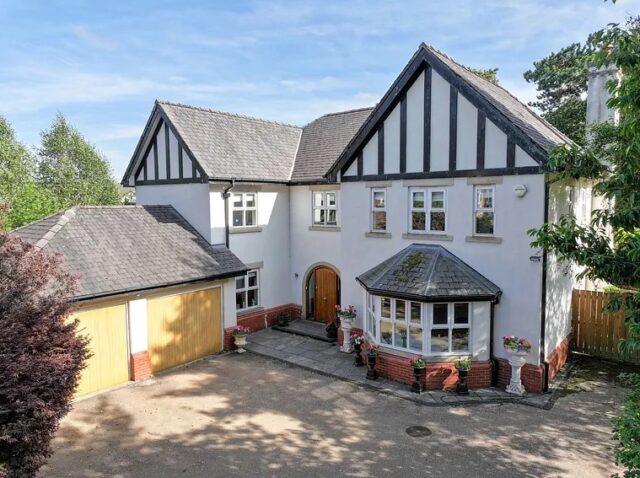
A good share of houses in Hale, Cheshire date from the Victorian and Edwardian years. High ceilings, bay windows, tiled hallways and fireplaces in nearly every room make them easy to fall for. They are also between a century and a century and a half old, and the things that go wrong with a house of that age are fairly predictable. Knowing where to look turns a viewing from a pleasant stroll into something more useful when looking at properties for sale in Hale.
Damp is often the gutter’s fault
People hear the word damp and think of rising damp, a rare problem that gets blamed far more often than it deserves. In a Victorian house the culprit is more often a blocked gutter, a cracked downpipe or a leaking joint, which soaks the wall from outside. Look at the brickwork under every gutter run and at the foot of every downpipe. Green staining, flaking paint or a tide-mark inside the same wall points to water arriving from above rather than rising from below.
Walls in these houses are solid, not cavity, and were built with lime mortar. Modern cement pointing or plastic paint on the outside can trap moisture that should evaporate, so ask what has been done to the walls and when.
Roofs and chimneys
Slate roofs last a long time, but the nails holding them in place don’t. Slipped or missing slates, sagging ridge lines and moss in the valleys suggest the roof is near the end of its life. Look at the chimney stacks, especially if the fireplaces are no longer used. An unused flue that has been capped without ventilation can cause damp on the chimney breast inside, and old stacks can lean or loosen after a hundred winters. Lead flashings round chimneys and bay windows are another common leak point.
Windows
Original timber sash windows are one of the best things about these houses, and also one of the most commonly torn out. Well-repaired sashes can be draught-proofed and perform surprisingly well, and secondary glazing improves them further. If the windows have been replaced, look at whether the new ones match the proportions and glazing bars of the originals. If the house is in a conservation area, check with the council before altering windows, boundary walls or front gardens, because rules differ from place to place.
Wiring, plumbing and heating
Ask when the electrics were last tested and look at the fuse board. An old rubber-cased cable or a board with a row of rewirable fuses is a sign that work is due. Lead water pipes are still found in some pre-war houses, and if the supply pipe is lead it is worth replacing. Check that the central heating is sized for tall rooms, because a boiler fitted for a modern semi may struggle in a Victorian house with fourteen-foot ceilings.
Which survey to choose
A basic valuation tells a lender what the house is worth and little else. For an older property, most surveyors recommend a Level 3 Building Survey, which looks at the construction in detail and covers defects, the likely causes and what to do about them. It costs more than a Level 2, and on a house of this age the extra money is usually well spent. Read the report with the surveyor on the phone if you can, and ask them which three items they would fix first.
Keep the original features that matter
Cornicing, ceiling roses, sash windows and encaustic tiles are expensive to replace and cheap to maintain. A house that has kept them has more to offer a future buyer, and they are the details that make an older house worth the extra care it needs.