
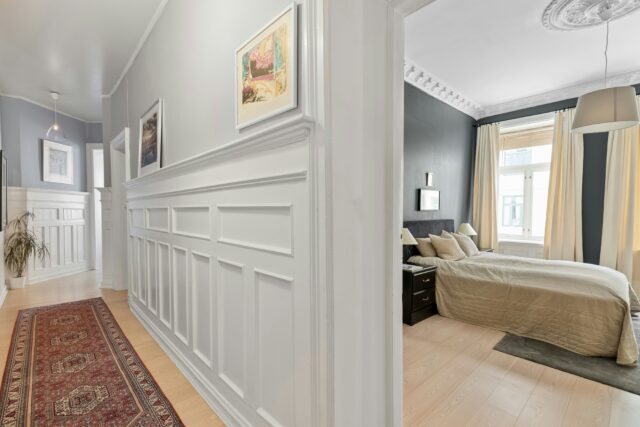
Ever walked into a room and thought “this just feels… proportioned” without knowing why? Chances are, the skirting boards had something to do with it.
Georgian style skirting boards have been doing exactly that job since the 1700s — and somehow, they still work. Symmetry, restraint, proportion: these were the obsessions of Georgian architects, and that philosophy trickled down into every detail, skirting included. Centuries later, it’s still one of the most specified profiles in renovation projects.
Curious why a design from the 18th century keeps showing up in 2026 builds? There’s a reason.
Where it all started
Georgian design wasn’t about decoration for decoration’s sake. It was about balance — symmetry, proportion, restraint. Cornices, architraves, skirting boards, all followed the same logic.
Compared to what came later (Victorian interiors, with their layered, ornate everything), Georgian skirting was relatively understated. Taller than earlier styles, sure, but simple. Structured without being fussy. That restraint is exactly what’s aged so well.
What “Georgian style” actually means now
Modern versions aren’t museum reproductions. Nobody’s milling these by hand with period tools. Instead, manufacturers capture the feel — the proportions, the subtle detailing — using contemporary materials and methods.
What you’ll typically find: taller heights than standard modern skirting, layered or stepped profiles, gentle curves paired with cleaner lines, and an overall emphasis on proportion rather than ornamentation. The result bridges classical architecture and current interiors without forcing either to compromise much.
Proportion. It’s everything, honestly.
Here’s the core Georgian principle: skirting height should match the room.
Taller skirting anchors a wall — especially useful in rooms with high ceilings, where a slim, low-profile board can look almost lost. Go too small in a room built around classical proportions, and something just feels… off. Hard to describe, easy to notice.
What actually determines the right height? Ceiling height obviously. But also door and window proportions, the overall interior style, flooring thickness, and whatever other mouldings are already in the room. Get these working together, and skirting stops being “a detail” and starts being part of the room’s structure.
What it’s made from these days
Traditional Georgian interiors used solid timber — full stop, that’s all there was. Now? More options.
Solid wood still exists for restoration purists — natural grain, genuine heritage feel. MDF has become the go-to for most contemporary homes: smooth finish, consistent quality, takes paint beautifully. And engineered wood splits the difference — stability of manufactured material, appearance closer to the real thing.
Each has trade-offs. Solid wood for authenticity. MDF for affordability and ease. Neither is “wrong” — depends what you’re after.
Not just decoration — it actually does something
Easy to forget skirting has a job beyond looking nice. It protects walls — from furniture scuffs, vacuum cleaner bumps, general foot-traffic wear, the small impacts that accumulate over years.
Georgian profiles handle this just as well as anything else — arguably better, given the taller heights offer more coverage. Form and function, both boxes ticked.
Where it actually gets used
Despite the historical pedigree, Georgian style skirting boards show up well beyond period homes.
Obviously period renovations — restoring or complementing original character. But also new builds chasing a sense of permanence and tradition (lots of developers go this route). Transitional interiors — blending modern furniture with classic architectural bones — lean on it heavily too. And anywhere with high ceilings that need visual grounding, Georgian profiles tend to be the default recommendation.
That range is, frankly, the whole reason it’s stayed relevant this long.
How it stacks up against other profiles
Simple modern skirting — square edges, minimal detail — works fine in contemporary spaces but can look flat in larger or more traditional rooms. Not bad, just… thin, visually.
Victorian profiles sit at the other extreme: intricate, layered, ornate. Striking in the right setting, but overwhelming in smaller or more minimalist rooms. Too much, too fast.
Georgian sits right in the middle. Enough detail to feel intentional, not so much that it dominates. That middle ground is precisely why it’s so adaptable.
Picking the right one for your space
This isn’t purely aesthetic — it’s contextual. What’s the age and style of the property? How much decorative detail feels appropriate? What’s the budget? What’s the maintenance tolerance? And critically — does it actually work with the flooring and wall finishes already chosen?
Get this right, and skirting quietly improves a room’s proportions. Get it wrong, and it actively disrupts the visual balance — sometimes in ways people notice without being able to say why.
Fitting it properly matters more than you’d think
Installation quality makes or breaks the final look. Clean joints, consistent alignment, no visible gaps between board and wall — all of this affects both appearance and how long the finish lasts.
Once fitted: fill joints and nail holes, sand where needed, prime (if it’s paintable), then finish with paint or stain. Skip steps here, and even the right profile can end up looking sloppy.
Worth comparing before you commit
Height, thickness, profile depth — these vary more between products than people expect, and the differences matter once installed. Anyone planning a renovation should spend time looking at georgian style skirting boards specifically, comparing dimensions and finishes across options before ordering anything in bulk. Saves headaches later.
What’s trending
Taller profiles are having a moment — stronger architectural definition, more presence in a room. Painted finishes remain dominant too, particularly in neutral or monochrome schemes where skirting either blends in or deliberately contrasts.
And there’s a growing appetite for mixing eras — Georgian-profile skirting alongside minimalist furniture and modern layouts. Not a contradiction, apparently. More like… permission to mix.
Bottom line
Georgian style skirting boards have survived this long because they solve a problem that never really goes away: how do you add structure and refinement to a room without overdoing it?
Whether it’s a period property, a new build chasing classic character, or a renovation somewhere in between, getting the proportions and materials right turns skirting from an afterthought into something that quietly makes the whole room work better. Worth the extra thought.